Map of Rockford
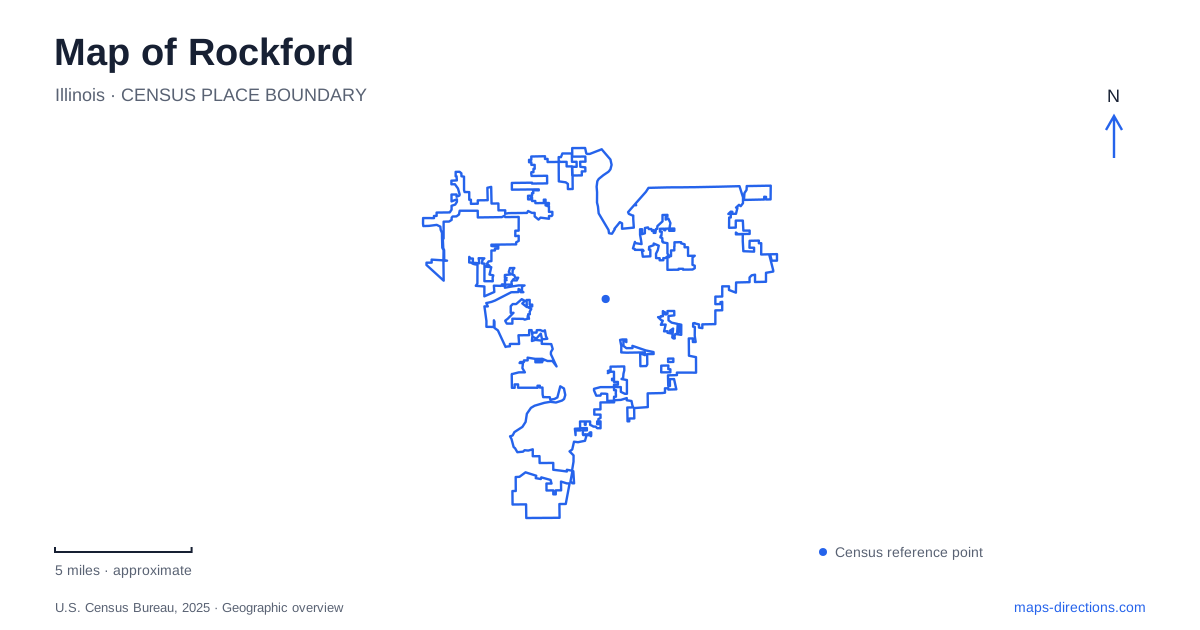
Street tiles load from OpenStreetMap when opened. The blue line shows the 2025 Census boundary.
- State
- Illinois
- Population · July 2025
- 147,384
- Land area
- 65.4 sq mi
- Water area
- 1.0 sq mi
Rockford's cultural geography follows several different landscapes. The Rock River organizes downtown and a chain of riverfront destinations, while Spring Creek provides the setting for a carefully designed Japanese garden. Farther from the central river corridor, a museum campus interprets the region's industrial and community history. Reading these places through their streets and water relationships gives a more useful picture than treating every museum or garden as part of one central attraction district.
State Street crosses the downtown river landscape
The visitor bureau describes downtown as the center of the River District, with commercial activity, entertainment, public art and recreation associated with the Rock River. Its own office stands at North Main and West State Street. State Street provides a crossing between the two banks, giving the center a relationship across the water rather than confining it to one side.
For Rockford, the river is therefore both an organizing feature and something to cross. Downtown's districts and destinations belong to streets on either bank. An event route that travels from Main Street across the State Street Bridge illustrates this relationship clearly: the crossing joins parts of the central street network rather than leading out of downtown altogether.
Keeping the street names alongside the river helps explain the different settings of an urban visit. A waterfront venue, a shop on State Street and a museum farther along North Main can share a broad downtown identity while occupying distinct positions within it.
North Main has a concentrated museum setting
Riverfront Museum Park is at 711 North Main Street. Discovery Center Museum identifies this as its home, and the Rockford Art Museum also locates itself within the building. The shared address represents several institutions, so the building name alone does not identify which collection or program a visitor intends to see.
Burpee Museum of Natural History uses the nearby address of 737 North Main Street. The two addresses reveal a cultural cluster along the same street, while preserving the separate buildings and organizations. That is a more precise understanding than merging every institution into one museum ticket or entrance.
This part of the map rewards close attention to the institution name. Natural history, hands-on science and visual art are different subjects presented in neighboring settings. Their proximity makes the area recognizable as a cultural destination, but each museum retains its own purpose and visitor arrangements.
Sinnissippi's conservatory brings plants to the riverbank
Nicholas Conservatory & Gardens occupies a Rock River setting at 1354 North Second Street. Its operator describes a tropical plant environment associated with the Sinnissippi riverfront. The glasshouse creates a cultivated indoor landscape beside an outdoor river corridor, giving this destination a different character from a conventional city museum.
The North Second Street address also separates it from the North Main museum cluster. Similar phrases such as riverfront attraction can obscure that distinction when directions are shortened. Retaining the street reference makes clear which property is meant, while the river supplies the broader geographic connection.
The conservatory's setting combines built structure, horticulture and surrounding open space. A map of the grounds can distinguish the indoor plant collection from an outdoor walk, even though both belong to the same visit. The glasshouse is a destination within the landscape rather than a name for the whole riverside.
Spring Creek has a deliberately composed garden
Anderson Japanese Gardens is at 318 Spring Creek Road. Its history dates construction to 1978, when John Anderson worked with designer Hoichi Kurisu to transform a wet backyard beside Spring Creek. The placement of stone, trees and paths was part of a carefully considered design, not simply the preservation of an untouched natural area.
Rockford's two garden destinations consequently tell different stories. Nicholas uses a conservatory to support a tropical collection beside the main river; Anderson's landscape responds to a creek setting through Japanese garden design. Their individual names and addresses matter because the general category garden does not explain those differences.
Guilford Road leads to a broader historical campus
Midway Village Museum uses 6799 Guilford Road. Its main museum interprets local industry, immigration, aviation and community life, while the grounds include a Victorian village and a recreated mill beside Lake Severin. Indoor exhibits and outdoor historical settings are different components of the campus.
A map of Rockford can hold these places together without compressing them into one museum district. Downtown's river crossing, the North Main cultural cluster, the conservatory on North Second, the designed Spring Creek garden and the Guilford Road history campus each reveal a different relationship between institutions and landscape. Those relationships give visitors a grounded way to understand where the city's cultural destinations actually belong.
Map and statistics: U.S. Census Bureau, 2025 Gazetteer, January 2025 generalized place boundaries and Vintage 2025 population estimates. Local references: GoRockford; Discovery Center Museum; Rockford Art Museum; Burpee Museum of Natural History; Nicholas Conservatory & Gardens / Rockford Park District; Nicholas Conservatory & Gardens; Anderson Japanese Gardens; Midway Village Museum. Article prepared by Maps & Directions.