Map of Oak Park
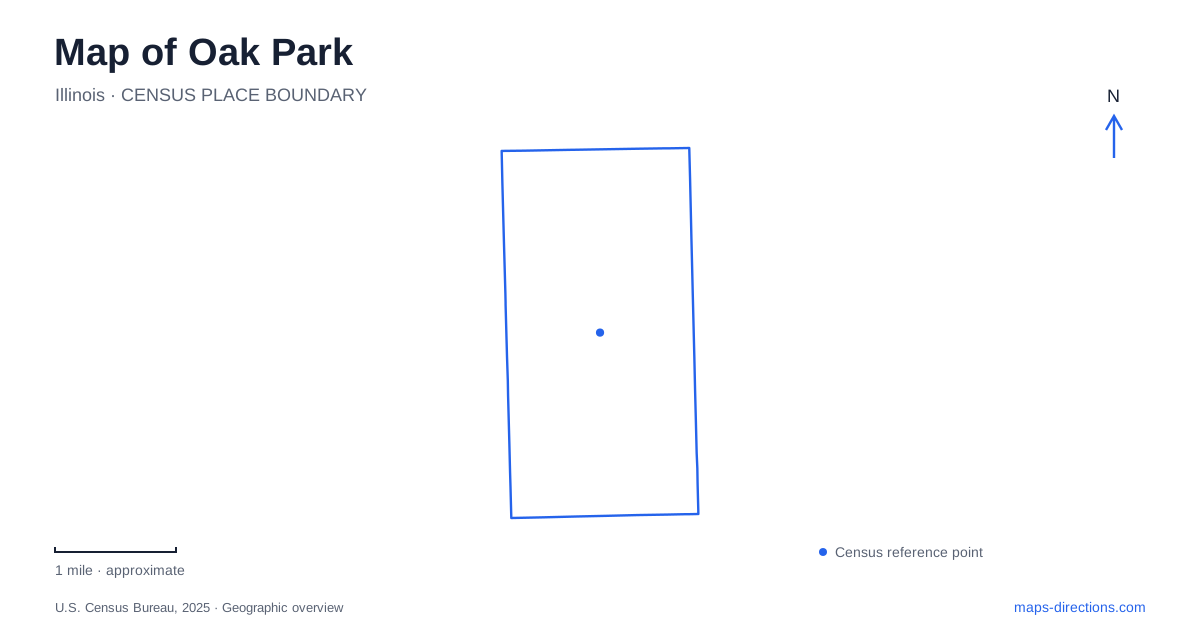
Street tiles load from OpenStreetMap when opened. The blue line shows the 2025 Census boundary.
- State
- Illinois
- Population · July 2025
- 52,823
- Land area
- 4.7 sq mi
- Water area
- 0.0 sq mi
Oak Park's map rewards attention to individual streets. Lake Street connects important commercial and civic places, Chicago Avenue anchors Frank Lloyd Wright's Home and Studio, and residential blocks contain buildings that make the village an architectural destination. The railway corridors add another organizing layer. A visit becomes easier to plan when the landmarks are grouped geographically, rather than treated as one continuous museum district with a single admission or entrance.
Lake Street and Unity Temple
Unity Temple stands at 875 Lake Street, at Kenilworth Avenue. Its concrete exterior and strong geometric forms make it a distinctive landmark within an active urban street. Wright designed the building for a congregation whose previous church had burned, using reinforced concrete in a way then more commonly associated with industrial construction. The building accommodates both worship and community functions, which helps explain its arrangement of connected spaces.
Its setting matters to the design. The Frank Lloyd Wright Trust describes a building that turns inward in response to a busy street, with high windows admitting light above the immediate surroundings. Seeing the exterior from Lake Street and then experiencing the interior reveals a deliberate contrast. This is a religious building that also receives architectural visitors, so a tour belongs within the operator's visitor arrangements rather than being assumed from the presence of a landmark symbol.
Scoville Park, at 800 Lake Street, provides a nearby public-space reference. The park and temple make this section of the street useful for orienting a wider walk. Lake Street can also serve as the transition between the commercial district and the quieter residential routes leading north.
Wright's workplace and the surrounding houses
The Frank Lloyd Wright Home and Studio uses 951 Chicago Avenue as its visitor address. Wright developed architectural ideas in his own house and worked with associates in the adjoining studio. The two functions are physically connected, but they explain different aspects of the site: family living space and the production of designs for other buildings.
This part of Oak Park is best understood through both an interior visit and the surrounding streets. The Trust offers a neighborhood audio tour alongside the guided house and studio tour. That distinction is useful because many nearby Wright-designed residences are private homes, while the Home and Studio is an organized visitor site. The neighborhood's significance comes from the buildings' relationship to ordinary streets and lots, not from every property operating as a public attraction.
An architectural itinerary can therefore use Chicago Avenue as its northern reference and Lake Street as another major stop. The walk between them is part of the experience, allowing changes in building scale and street character to become visible rather than simply moving between two labeled attractions.
Hemingway and a separate strand of local history
The Ernest Hemingway Birthplace Museum is at 339 North Oak Park Avenue. The foundation describes its location as six blocks north of the Green Line stop on the same avenue. That provides a straightforward street-based relationship for a visitor arriving by transit, without needing to treat the entire village as the destination.
The birthplace adds literary history to an area often associated primarily with architecture. It also creates a useful reason to explore a different north–south route from the one chosen for the Wright sites. A combined day should account for separate tour arrangements at the two institutions. The museums illuminate different people and subjects, even though their neighborhood settings make them natural companions on a local map.
Pleasant Home and the southern destinations
Pleasant Home stands in the northeast corner of Mills Park. Designed in 1897 by George W. Maher for John W. Farson, it introduces another major Prairie School architect to the itinerary. This is a particularly useful counterpoint to Wright-focused sightseeing: the village's architectural history includes more than the work of its most famous resident.
The park district lists Mills Park and Pleasant Home at 217 South Home Avenue. Farther south, the conservatory at 615 Garfield Street offers a different kind of visit centered on plants rather than house architecture. These destinations broaden an Oak Park outing beyond the streets north of Lake. Plotting them separately also prevents an overly ambitious walking plan built around the assumption that every prominent attraction occupies the same few blocks.
Choosing the railway corridor
The village is served by CTA's Green and Blue lines and Metra's Union Pacific West line. These are separate services, so the line and station name matter more than a general search for a train to the village. For the Lake Street landmarks, the Wright Trust describes an approach from the Green Line stop, walking north toward Lake Street.
A map of Oak Park works well as a set of connected local walks: Lake Street and Unity Temple, the Home and Studio neighborhood, the Hemingway birthplace route, and Mills Park. Selecting a starting station and one or two of these areas produces a more coherent visit than racing between every landmark, while leaving the streets themselves room to explain the place.
Map and statistics: U.S. Census Bureau, 2025 Gazetteer, January 2025 generalized place boundaries and Vintage 2025 population estimates. Local references: Frank Lloyd Wright Trust; Park District of Oak Park; Ernest Hemingway Foundation; Village of Oak Park. Article prepared by Maps & Directions.