Map of Iowa City
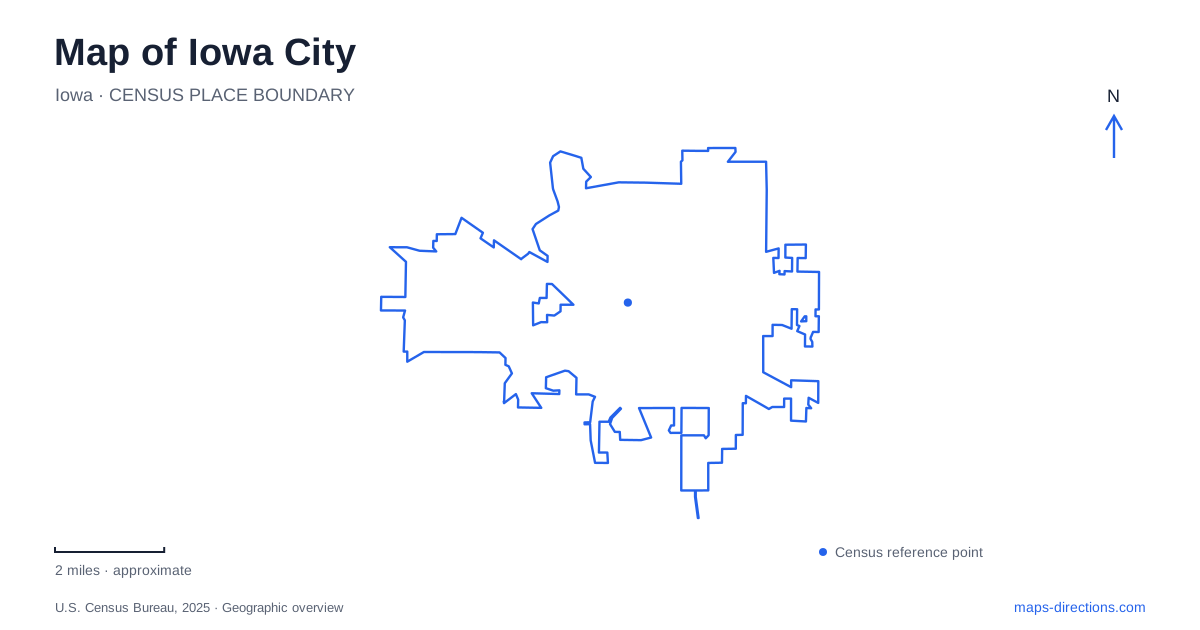
Street tiles load from OpenStreetMap when opened. The blue line shows the 2025 Census boundary.
- State
- Iowa
- Population · July 2025
- 76,229
- Land area
- 25.8 sq mi
- Water area
- 0.5 sq mi
Iowa City has a downtown where university grounds and ordinary streets meet with unusually little separation. The gold-domed Old Capitol is the central landmark, but the Iowa River adds a second organizing feature: campus destinations spread across its banks, while downtown's shops and pedestrian spaces gather around a more compact street grid. A useful map balances these two scales, keeping the civic and cultural center legible without treating the entire university as one small destination.
Four streets around the Pentacrest
The Pentacrest occupies the block bounded by Clinton Street, Washington Street, Madison Street, and Jefferson Street. Those four edges create a dependable frame for the oldest campus landscape. Old Capitol stands at its center, with an official museum address of 21 North Clinton Street. Its original role as the state's capitol explains why the building looks different from a conventional academic hall: the university inherited a seat of government as part of its physical identity.
The Museum of Natural History is in Macbride Hall, also within the Pentacrest setting. This produces a compact pairing of state history and natural history, surrounded by educational buildings and open grounds. Old Capitol has no separate visitor parking lot; the museum identifies nearby university and municipal ramps instead. On a downtown map, the lawn and its surrounding streets are consequently more useful orientation features than a search for a museum driveway.
Literature at pavement level
Iowa City's literary identity is expressed along public routes as well as inside university buildings. The Iowa Avenue Literary Walk places writers' names and work into the downtown landscape. The university library's literary map identifies stops for Flannery O'Connor, Kurt Vonnegut, Ray Young Bear, Mildred Wirt Benson, and other authors. This makes Iowa Avenue a cultural route that can be read a little at a time, rather than a single attraction behind an entrance desk.
Nearby, the municipal listing for Blackhawk Mini Park and the Pedestrian Mall uses 104 South Dubuque Street as its reference address. The two-acre public space includes a fountain, seating, a stage, and a playground. Its value on a map is the space between buildings: a place for lingering and gathering within the downtown grid. The literary walk and the pedestrian mall illustrate two different kinds of public culture, one encountered through individual texts and the other through a shared outdoor room.
Art and performance across the campus landscape
The Stanley Museum of Art is at 160 West Burlington Street beside Gibson Square Park. Its present building opened in August 2022, after the collection's long displacement following the 2008 flood. The museum's purpose-built home includes a central lightwell that helps organize its interior and bring daylight into adjacent spaces. That location belongs to the Burlington Street side of campus, not the River Street arts buildings.
Across the broader Iowa City campus landscape, the Visual Arts Building at 107 River Street serves teaching and studio work. Designed by Steven Holl and opened in 2016, it also belongs to the university's reconstruction following the flood. The distinction matters culturally as well as geographically: the Stanley is a collecting museum, while the Visual Arts Building is part of the working environment where students and faculty make art.
Hancher Auditorium has another river-oriented setting at 141 East Park Road. Its main entrance and accessible drop-off face the river; the small box-office parking area lies on the southwest, non-river side. University guidance identifies pedestrian bridges near the Iowa Memorial Union and Stanley Hall as ways to approach Hancher across campus. These crossings connect the arts destinations into a walkable network, although the building addresses remain spread along different streets and banks.
Two outdoor landscapes beyond downtown
Hickory Hill Park offers a contrasting Iowa City landscape: 185 acres acquired in 1967, with primitive limestone, wood-chip, and dirt trails. Its north access is at 800 Conklin Street and its south access at 1439 Bloomington Street. The city locates accessible amenities around these entrance areas, while describing the internal trails separately. The park therefore reads as a large natural area with two developed edges, not as an extension of downtown's paved pedestrian spaces.
Terry Trueblood Recreation Area has a lakeside setting at 579 McCollister Boulevard. Its Park Lodge is a reservable building with a patio overlooking the recreation landscape. The lake is an important feature, but its presence does not establish permission to swim; consult the municipal recreation rules for allowed activities and water conditions. Together, these parks broaden an Iowa City itinerary from museums and streets to trails and water, each with a different physical character and intended use.
Map and statistics: U.S. Census Bureau, 2025 Gazetteer, January 2025 generalized place boundaries and Vintage 2025 population estimates. Local references: University of Iowa; University of Iowa Libraries; City of Iowa City; University of Iowa Stanley Museum of Art. Article prepared by Maps & Directions.