Map of Carol Stream
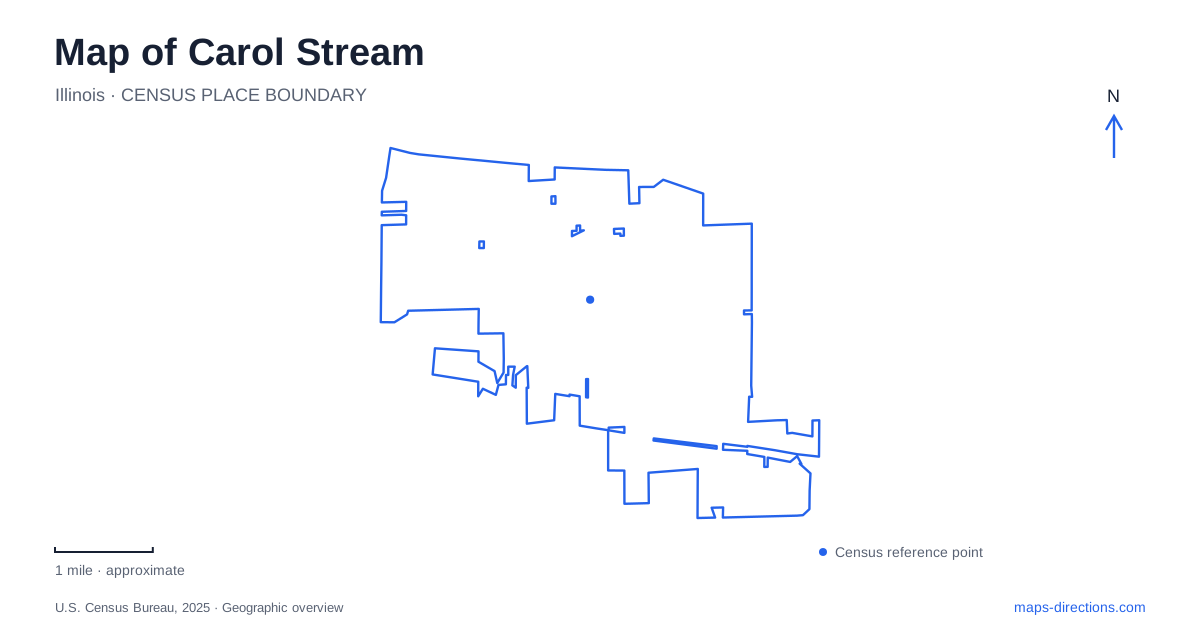
Street tiles load from OpenStreetMap when opened. The blue line shows the 2025 Census boundary.
- State
- Illinois
- Population · July 2025
- 39,315
- Land area
- 9.3 sq mi
- Water area
- 0.3 sq mi
Carol Stream's name can mislead someone encountering it for the first time on a map. It honors the daughter of founder Jay Stream, rather than a local watercourse. Actual creeks nevertheless play an important role in the village's public landscape, particularly where parks combine recreation with flood management. The result is a suburban map with several overlapping stories: an older farming and railway community, a village incorporated in 1959, and a network of parks that follows both neighborhood needs and drainage corridors.
Gretna came before the planned village
Before modern residential development, the area included farms associated with families such as the Kelleys. Daniel Kelley settled in the area in the 1840s and donated land for the Chicago Great Western Railway. The settlement around the railway stop became known as Gretna after 1887.
That older name survives in local historical interpretation even though it is not the municipality's present name. St. Stephen Cemetery is another surviving connection to the earlier settlement; the associated nineteenth-century church no longer stands. These traces show that incorporation did not create the first community on the land. Carol Stream developed over an existing rural geography, absorbing places whose names and institutions had already acquired meaning. A historical map and a contemporary village map therefore organize the same area around different reference points.
A gathering place on Gary Avenue
Ross Ferraro Town Center is at 960 North Gary Avenue. The village describes its purpose as a shared gathering place in a community without a centralized traditional downtown. Its fountain, walking paths, performance gazebo, and visitor facilities create a civic destination within a broader suburban pattern.
This is different from a commercial center that grew gradually around a nineteenth-century railway station. The town center was deliberately developed to provide public space for events and community life. Its layout and identity make more sense when read as an answer to that need. The fountain is a recognizable feature, but the surrounding gathering spaces are equally important to understanding the site. A map centered only on shops or municipal offices can miss this separate social center of Carol Stream.
Armstrong Park combines several landscapes
Armstrong Park, named for astronaut Neil Armstrong, contains railway heritage as well as recreation. The south parking area is associated with Gretna Station and a caboose. Paths continue around the reservoir toward Lake George and Balog Island, which the park district identifies as a place used by purple martins.
The northern part of the park includes a picnic shelter, ball field, and KidsWorld playground. The playground was redesigned in 2016 while retaining elements of its earlier identity, including reused towers and personalized fence pickets. This means the park can serve quite different visits: viewing historical features, attending a game, walking beside water, or using a playground. Knowing which portion contains the intended activity is more informative than relying on a single park marker.
The reservoirs are working infrastructure
Water at Armstrong Park also has a specific flood-control purpose. DuPage County completed a two-reservoir system in 2015 with capacity for about 37 million gallons of floodwater. When Klein Creek rises, the first reservoir receives water, and pumps transfer it into the larger second storage area. After creek levels fall, a siphon returns stored water downstream.
For Carol Stream, the project demonstrates how a recreation landscape can also protect nearby neighborhoods. The reservoirs' shape and position are related to drainage engineering, not simply ornamental lake design. Paths and park activities coexist with this operational purpose. Reading the water features in that context explains why the landscape includes substantial open storage space and why water levels do not necessarily remain constant throughout the year.
Red Hawk connects across a major road
Red Hawk Park occupies former Lenz family farmland, with Klein Creek running through it. Its walking and cycling path connects south toward the Great Western Trail and north beneath North Avenue to the Bark Park and Barbara O'Rahilly Volunteer Park. From there, the route connects with the Kuhn Road trail.
The underpass is an important detail because North Avenue is a major road separating destinations that otherwise appear close together. The park combines natural creekside areas with sports fields and a barn-themed playground, preserving a reference to the site's agricultural past. Its principal parking is on West St. Charles Road; arrangements for some activities on the western side can differ. The landscape functions both as a destination and as part of a wider trail network.
The nearby farm landscape remains distinct
Timber Ridge Forest Preserve in West Chicago includes Kline Creek Farm, where interpretation focuses on farming in the 1890s. It also provides connections to the Great Western Trail and Illinois Prairie Path. The farmstead has different access rules from the surrounding preserve, including restrictions on bicycles, horses, and pets within the farm area.
That nearby destination helps place Carol Stream's own agricultural remnants in regional context without confusing the preserve with a village park. Together, Gretna's railway traces, the planned town center, flood-storage reservoirs, and connected creekside paths reveal how earlier land uses continue to shape an otherwise modern suburban map.
Map and statistics: U.S. Census Bureau, 2025 Gazetteer, January 2025 generalized place boundaries and Vintage 2025 population estimates. Local references: Village of Carol Stream; Carol Stream Park District; DuPage County Stormwater Management; Forest Preserve District of DuPage County. Article prepared by Maps & Directions.