Map of Canton
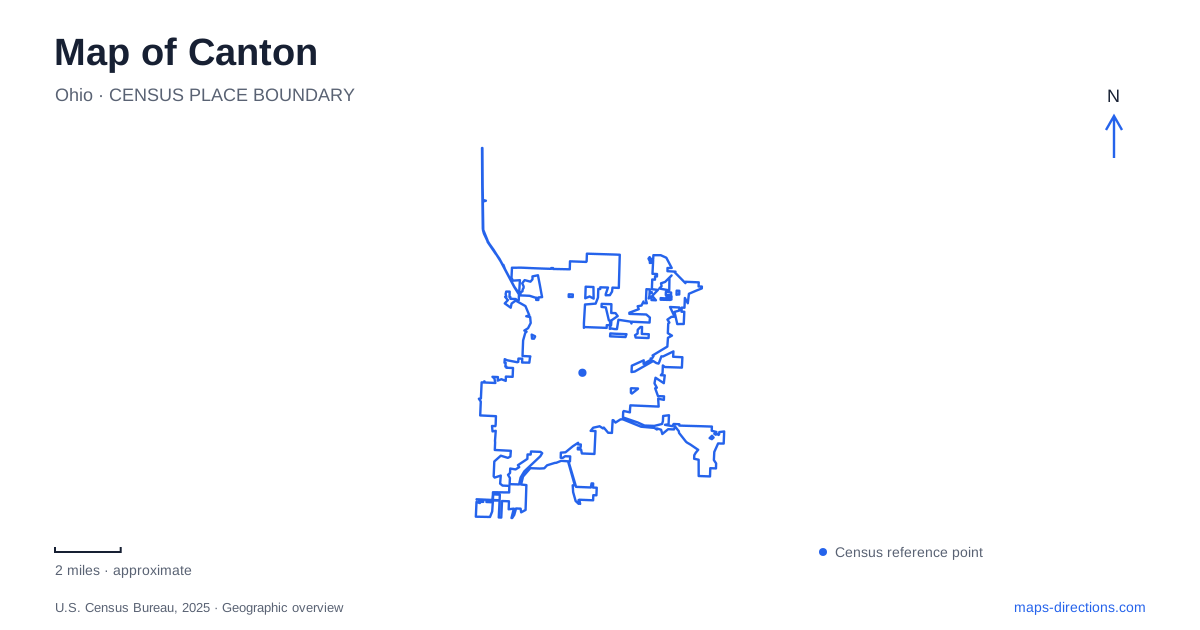
Street tiles load from OpenStreetMap when opened. The blue line shows the 2025 Census boundary.
- State
- Ohio
- Population · July 2025
- 69,001
- Land area
- 26.3 sq mi
- Water area
- 0.0 sq mi
Canton's best-known stories occupy several different parts of the city. Market Avenue links downtown presidential history with performing and visual arts. The McKinley memorial and museum form another destination on Monument Drive, while the Pro Football Hall of Fame stands on George Halas Drive. A useful map keeps those clusters separate before connecting them into a wider visit, because a common historical theme does not mean the buildings share one campus.
Two buildings tell the First Ladies story
First Ladies National Historic Site consists of the Saxton-McKinley home and a visitor-center property in downtown. The National First Ladies Library and Museum uses 205 Market Avenue South, while the Saxton House is at 331 Market Avenue South. Both belong to the same interpretive experience, but their separate addresses reflect distinct buildings along the street.
The house was the family home of Ida Saxton McKinley. The National Park Service identifies it as the remaining local residence with direct historical ties to President William McKinley. The visitor-center exhibitions place that personal history within the broader role of First Ladies. For someone walking through Canton, the two-site arrangement offers a useful distinction between an individual's domestic setting and a museum's wider national subject. Keeping both street numbers in the plan makes that relationship concrete.
The memorial occupies a different Canton setting
The McKinley Presidential Library and Museum is at 800 McKinley Monument Drive Northwest, with the National Memorial on its grounds. The memorial is the burial place of William and Ida McKinley and their two daughters. Its broad stairway contains 108 steps, giving the approach a monumental scale very different from the Market Avenue house.
The neighboring museum broadens the subject beyond the presidential family. Its galleries include the Stark County Story, a historical Street of Shops, science exhibits, and the Hoover-Price Planetarium. This combination makes the property a county-history and science destination as well as a presidential one. A map that marks only the monument dome can miss the purpose of the adjacent museum building. The grounds bring those experiences together while remaining distinct from downtown's First Ladies sites.
Market Avenue's performance landmark
At 605 Market Avenue North, the Palace Theatre opened in November 1926 as a vaudeville and movie house. Architect John Eberson designed it as an atmospheric theater, part of a period when elaborate interiors transformed a night at the movies into a larger visual experience. Its presence on Market Avenue makes the north–south street a cultural corridor as well as a route through downtown.
The building also carries a particularly local commercial story. Benefactor Harry Harper Ink owned the Tonsiline cough-syrup company, whose product used giraffe-shaped bottles. Two giraffe plaques above the proscenium recall that business identity. These are small architectural details with a specific reason for being there, rather than decoration chosen without local meaning. Canton can be read through such connections between industry, patronage, and public entertainment, all concentrated in one theater building.
Visual arts farther along the same avenue
The art museum's address at 1001 Market Avenue North extends the cultural sequence beyond the Palace. It is associated with the Cultural Center for the Arts, another institutional setting with its own building and visitor arrangements. The progression from Market Avenue South to the higher northern street numbers provides a straightforward way to organize the downtown area without assuming all attractions occupy adjacent doors.
This street-based approach is useful for comparing plans. A visit focused on the First Ladies buildings emphasizes the southern addresses, while theater and art museum activities pull the itinerary north. The cultural corridor is a collection of institutions along a common street, each with a different purpose. Its geography is clearer when the named buildings remain visible within the overall downtown view.
Football's founding place and its museum
The Pro Football Hall of Fame is at 2121 George Halas Drive Northwest. Its subject reaches back to a 1920 meeting held in Ralph Hay's Hupmobile showroom, where representatives organized the association later renamed the National Football League. The Hall's historical account notes that the original Odd Fellows Building containing the showroom was demolished and its site commemorated with a marker.
That distinction prevents a common historical misunderstanding: the museum is a place for interpreting the league, while the founding meeting occurred in a different commercial building. Canton preserves this story through both an institution and a remembered site. Alongside the Market Avenue buildings and McKinley grounds, football history adds another layer to a map whose landmarks tell related stories from separate locations.
Map and statistics: U.S. Census Bureau, 2025 Gazetteer, January 2025 generalized place boundaries and Vintage 2025 population estimates. Local references: National Park Service; Visit Canton / McKinley Presidential Library and Museum; McKinley Presidential Library and Museum; Canton Palace Theatre; Canton Museum of Art; Pro Football Hall of Fame. Article prepared by Maps & Directions.